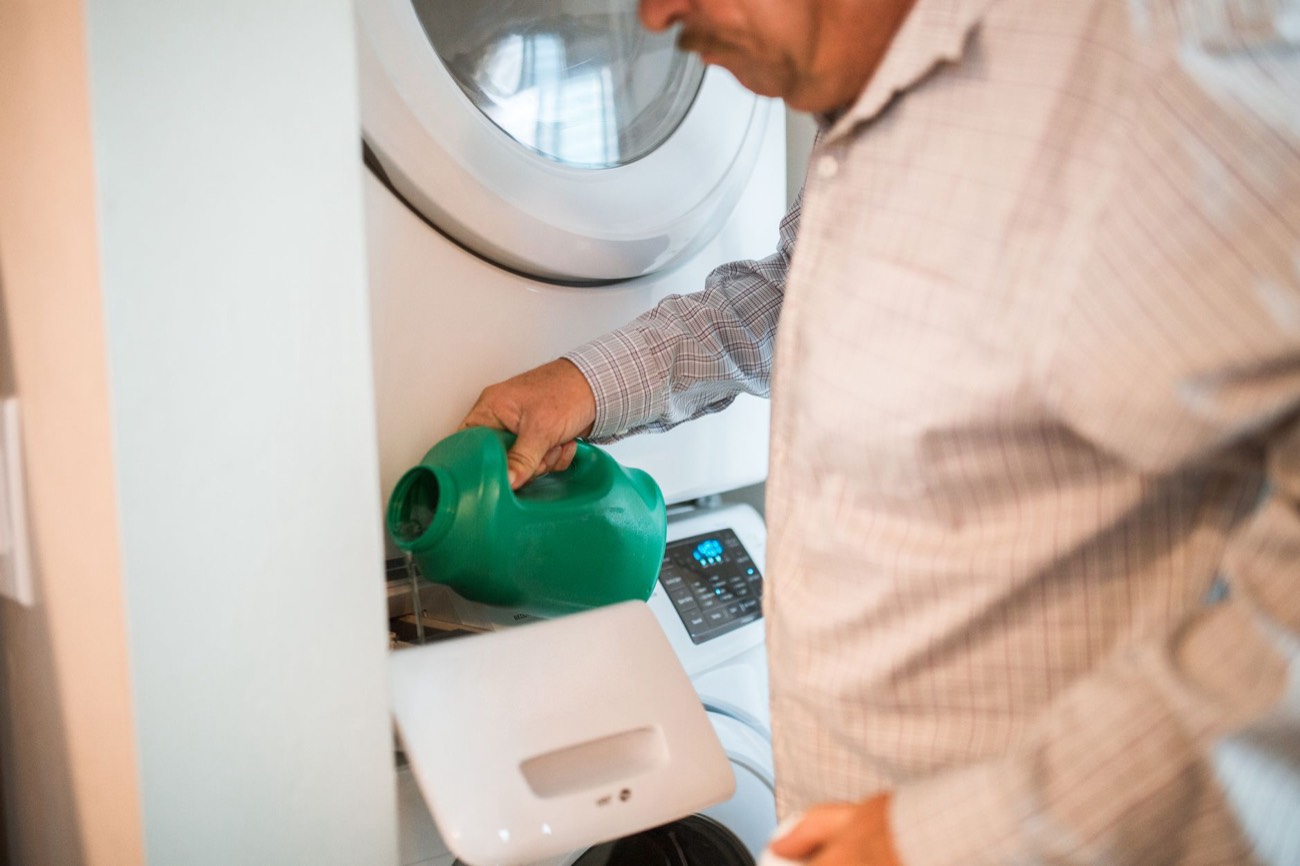
For a septic system, choose a liquid laundry detergent over powder. According to Purdue Extension, powder detergents often carry solid fillers that don’t fully dissolve — they sink to the bottom of your tank and build up as sludge, the layer you pay to have pumped out. Liquid formulas skip those fillers, so they’re the safer everyday pick. Beyond liquid-vs-powder, the rules are simple: don’t overdose the machine, go easy on chlorine bleach, and be cautious with fabric softeners and dryer sheets, which Purdue also flags as problematic. There’s no official “septic-safe” certification, so treat those claims on the bottle as marketing, not proof.
Why powder is the problem
Powdered detergents are built around a base of dry ingredients. Some of that is cleaning agent, but a chunk is filler — inert material that bulks up the box. In your washing machine, most of it dissolves. In your septic tank, the leftover undissolved solids don’t just disappear. They settle to the bottom and join the sludge layer.
That matters because sludge is exactly what pumping removes. The more solids you send down, the faster that layer grows, and the sooner your tank needs pumping. Liquid detergents don’t carry those fillers, so they add far less to the sludge. That’s the core of Purdue’s guidance and the single most useful thing to know when you stand in the detergent aisle.
What “septic-safe” actually means (and doesn’t)
You’ll see bottles labeled “septic-safe.” Here’s the honest picture: there is no government standard behind that phrase. The EPA doesn’t certify detergents, and neither does any university extension. So the label alone proves nothing.
What genuinely helps a septic system is behavior, not branding:
- Liquid over powder — the fillers rule above.
- Normal doses — more detergent doesn’t mean cleaner clothes; it means more chemicals reaching the tank.
- Easy on bleach — occasional diluted bleach is fine, but heavy chlorine use suppresses the bacteria that break down waste. Purdue lists excess bleach among the things that damage a tank.
- Go light on softeners and dryer sheets — Purdue flags both as problematic.
A plain liquid detergent used in a normal amount is septic-friendly whether or not the label says so.
Ingredients to favor and avoid
| Choose | Be cautious with | Why |
|---|---|---|
| Liquid detergent | Powder detergent | Powder fillers sink and build sludge |
| Normal dose | Overdosing / extra scoops | More chemical load reaches the tank |
| Occasional, diluted bleach | Heavy or frequent bleach | Excess bleach suppresses tank bacteria |
| — | Fabric softeners (liquid) | Purdue flags as problematic |
| — | Dryer sheets | Purdue flags as problematic |
Guidance from Purdue Extension HENV-106-W; bleach caution corroborated by EPA’s septic FAQ. There is no numeric “safe amount” of bleach in any authoritative source — claims of “X cups per week” are blog folklore, not EPA or extension guidance.
The bacteria are the whole point
Your septic tank works because anaerobic bacteria digest the solids that flow in. Anything that kills those bacteria in bulk slows the whole system down and, in the worst case, leaves you with a “dead” tank that stops breaking waste down properly.
Laundry is one of the biggest sources of chemicals entering a home septic system, simply because of how much water and product a wash cycle uses. That’s why detergent choice matters more than it seems. The good news: the anaerobic bacteria are resilient. Purdue’s research shows they recover from reasonable, diluted amounts of bleach. The risk comes from repeated heavy dosing — bleaching every load, pouring in extra softener, or overloading the machine with detergent.
For the fuller picture on chlorine specifically, see is bleach safe for septic systems.
Practical habits that protect the tank
You don’t need special products — you need a few consistent habits:
- Switch to a liquid detergent. The easiest single change.
- Measure your dose. Follow the low end of the label’s instructions; hard water aside, most people use too much.
- Spread out laundry. Running eight loads on Saturday floods the system with water all at once. Two loads a day across the week is gentler on the drain field.
- Skip antibacterial “sanitizing” additives in the wash — they’re aimed at killing bacteria, which is the opposite of what your tank needs.
- Ration the bleach. Reserve it for loads that truly need it, and dilute.
Spreading loads out also protects the drain field from hydraulic overload — the same principle behind not running a garbage disposal heavily, which adds solids the tank has to digest.
Fabric softeners and dryer sheets
Purdue specifically flags fabric softeners and dryer sheets as problematic for septic systems, and it’s worth understanding why. Liquid fabric softeners coat fabric with a thin film of conditioning chemicals — and that film, along with the surfactants that carry it, goes down the drain with the rinse water and into your tank. In large or frequent doses it adds to the chemical load the tank’s bacteria have to cope with.
Dryer sheets don’t go down the drain themselves, but the residue they leave washes out in the next cycle, and Purdue groups them with softeners as something to limit on a septic system. None of this means one dryer sheet ruins a tank. It means the cautious owner uses softeners and sheets sparingly rather than in every load. If you’re mainly fighting static, wool dryer balls are a septic-neutral alternative that skips the chemistry entirely.
What about phosphates and “eco” claims
Phosphates in detergents are a general environmental concern for waterways, and many detergents have reduced or removed them. For your septic tank specifically, phosphates aren’t the headline issue — fillers, bleach, and softeners are. Treat “phosphate-free” and “eco” as nice-to-haves, not as the deciding factor. The liquid-vs-powder choice does more for your system than any green label.
Does the washing machine itself matter?
Somewhat. A washing machine sends a large slug of water into the septic system in a short time, and a septic system prefers a steady flow over sudden surges. High-efficiency (HE) machines use noticeably less water per load than older top-loaders, which is easier on the tank and the drain field — less hydraulic load, and less chance of pushing water through the tank before solids have settled.
You don’t need to buy a new machine for your septic system’s sake, but if you’re replacing one anyway, an efficient model is the septic-friendly pick. Pair it with the habit of spreading loads across the week rather than doing every load on one day, and you protect the drain field from the overload that shortens its life. This is the same water-discipline principle behind the EPA’s efficient-water-use guidance for septic systems generally.
A simple detergent-aisle checklist
Standing in the store, you can decide in seconds:
- Is it liquid? If yes, good. If it’s powder, put it back.
- Does it need a normal dose? Avoid “ultra-concentrated” gimmicks that tempt you to pour more.
- Is it a plain detergent, not a “sanitizing” or heavy-bleach formula? Skip antibacterial add-ins.
- Are you also buying softener or dryer sheets? Buy less than you think you need, and consider wool dryer balls instead.
That’s the whole decision. Ignore the “septic-safe” badge, because as noted, no authority certifies it — your habits, not the label, keep the tank healthy.
Bottom line
Pick a liquid detergent, use a normal dose, go easy on bleach, and cut back on softeners and dryer sheets — that’s the whole septic-safe laundry playbook, and it comes straight from Purdue Extension. Ignore the “septic-safe” badge on the bottle; it isn’t certified by anyone. The real protection is keeping fillers and harsh chemicals out of the tank so the bacteria can do their job. For more on what belongs in your system and what doesn’t, see best septic-safe toilet paper and the broader question of is bleach safe for septic systems.